Need precision custom-cut signage in Toronto? Full Frame Signs offers state-of-the-art UV flatbed printing and digital CNC routing directly from our Etobicoke shop.
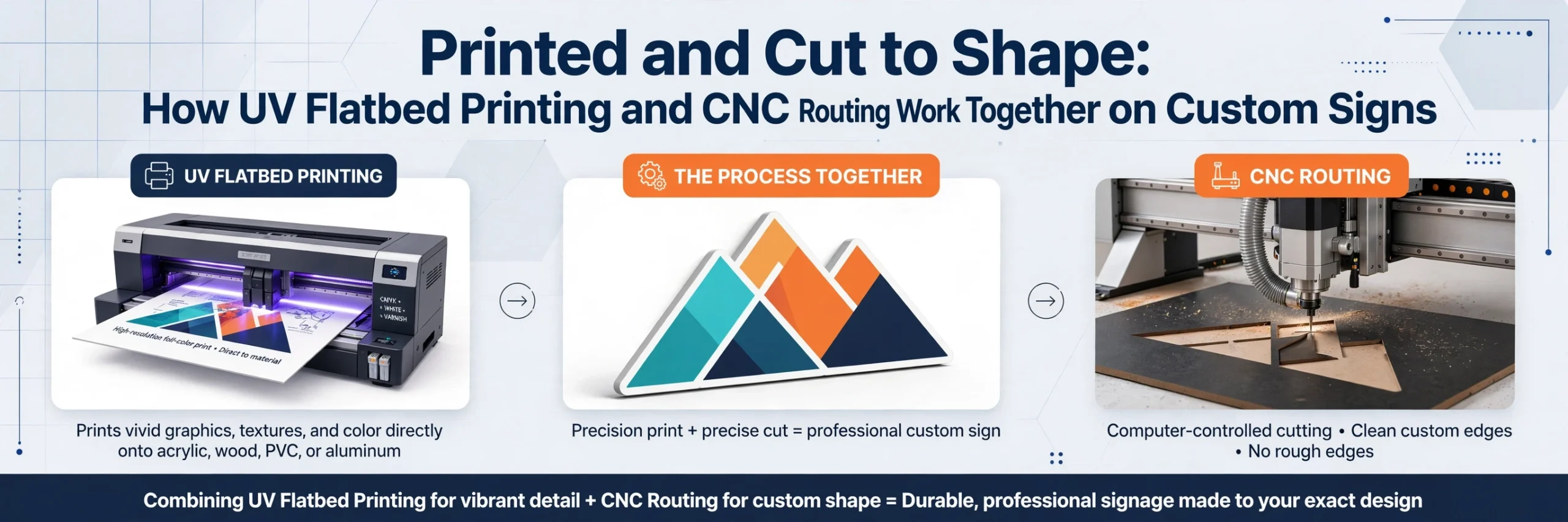
Printed, Then Cut to Shape: How UV Flatbed Printing and CNC Routing Work Together on Custom Signs
A rectangular sign is easy. The harder request is the sign shaped like your logo, a layered display with curves, or a set piece with a printed face and a precise outline. Jobs like that need two things done well on the same piece: printing and cutting. How those two steps are coordinated decides whether the finished sign looks sharp or slightly off.
Here’s how UV flatbed printing and CNC routing work together, and what to know before you order.
Why Combining Printing and Cutting Matters
When one shop handles both, the artwork and the cut path are planned together. When they’re split across vendors, a few things tend to go wrong:
- The printed edge doesn’t line up with the cut line, leaving a thin white border or clipped artwork.
- Files are prepared for printing but not for cutting, so the vendor has to rebuild them.
- Timelines stretch because each step waits on a separate shop.
- Nobody owns the final result if something is off.
Key Takeaway: Keeping print and fabrication under one roof simplifies production, eliminates file errors, and ensures seamless edge registration.
How the Process Works
1. Print Directly on the Material
High-resolution UV flatbed printing prints directly onto rigid sheets (such as ACM, PVC, acrylic, or foam board) rather than onto a vinyl film that must be mounted afterward. The UV-cured ink bonds instantly to the surface, eliminating separate lamination or mounting steps for most jobs.
2. Cut to the Outline
A CNC router follows a digital vector path to cut the printed sheet precisely to shape: a logo contour, rounded corners, intricate cut-outs, or standalone dimensional letters.
3. Finish the Edges
Depending on the material and intended use, edges are cleaned up, polished, or sealed, and any requested mounting studs or hanging hardware are attached.
The key detail is registration: the cutting machine must know exactly where the printed artwork sits on the sheet so the bit follows the exact artwork outline. Planning registration marks up front prevents visible misalignment.
What Substrates Can Be Printed and Cut?
Selecting the right rigid substrate depends on whether your project is designated for indoor or outdoor use and its required lifespan:
| Material | Primary Application | Key Performance Attributes |
|---|---|---|
| ACM (Aluminum Composite) | Exterior business signs & fascia panels | Extremely durable, weather-resistant, won’t warp outdoors |
| PVC (Expanded Sintra) | Indoor displays & sheltered exterior signs | Lightweight, smooth matte finish, clean router edges |
| Acrylic (Plexiglass) | Reception walls & high-end logo displays | Clean, glass-like polished look with deep visual clarity |
| Foam Board & Rigid Boards | Event signage & short-term displays | Cost-effective, lightweight, ideal for temporary indoor use |
Where Mixed Projects Come Up
Many commercial projects require multiple custom fabrication processes. Typical examples include:
- Storefront Packages: A printed and routed fascia panel, dimensional logo, entrance window vinyl graphics, and door decals produced together for perfect color consistency.
- Retail & Event Displays: Custom-shaped printed display pieces and heavy-duty floor graphics in Toronto manufactured as a unified campaign.
- Film & TV Sets: Printed signage cut to period-accurate shapes paired with specialty labels & decals and set dressing.
- Office & Lobby Installs: A CNC-routed logo feature wall complemented by matching directional wayfinding signage.
Artwork Requirements & Mistakes to Avoid
- Send Vector Artwork: Submit AI, EPS, or print-ready PDF files so text and graphics remain pin-sharp at any size.
- Include a Separate Cut Line: Place your desired cut path on its own layer using a distinct spot color so the router path doesn’t need to be recreated.
- Provide Safe Margins: Leave adequate margin (bleed) and keep critical artwork elements away from the perimeter to prevent accidental clipping.
- Specify Color Values: Include Pantone (PMS) or explicit CMYK values to maintain precise color matching.
- Order Matching Pieces Together: Ordering components in separate batches can cause slight color or finish variations. Ordering simultaneously ensures uniform results.
Printing and Fabrication Under One Roof in Etobicoke
Full Frame Signs combines high-resolution UV flatbed printing, precision CNC routing, and custom finishing at our Etobicoke shop, ensuring your design is printed and cut as one seamless, coordinated job. Tell us what you’re building, where it’s going, and your target timeline—we’ll recommend the ideal materials and process to match.
Get A Free Quote
Fast, custom UV printed and CNC routed signs for Toronto businesses.
Full Frame Signs
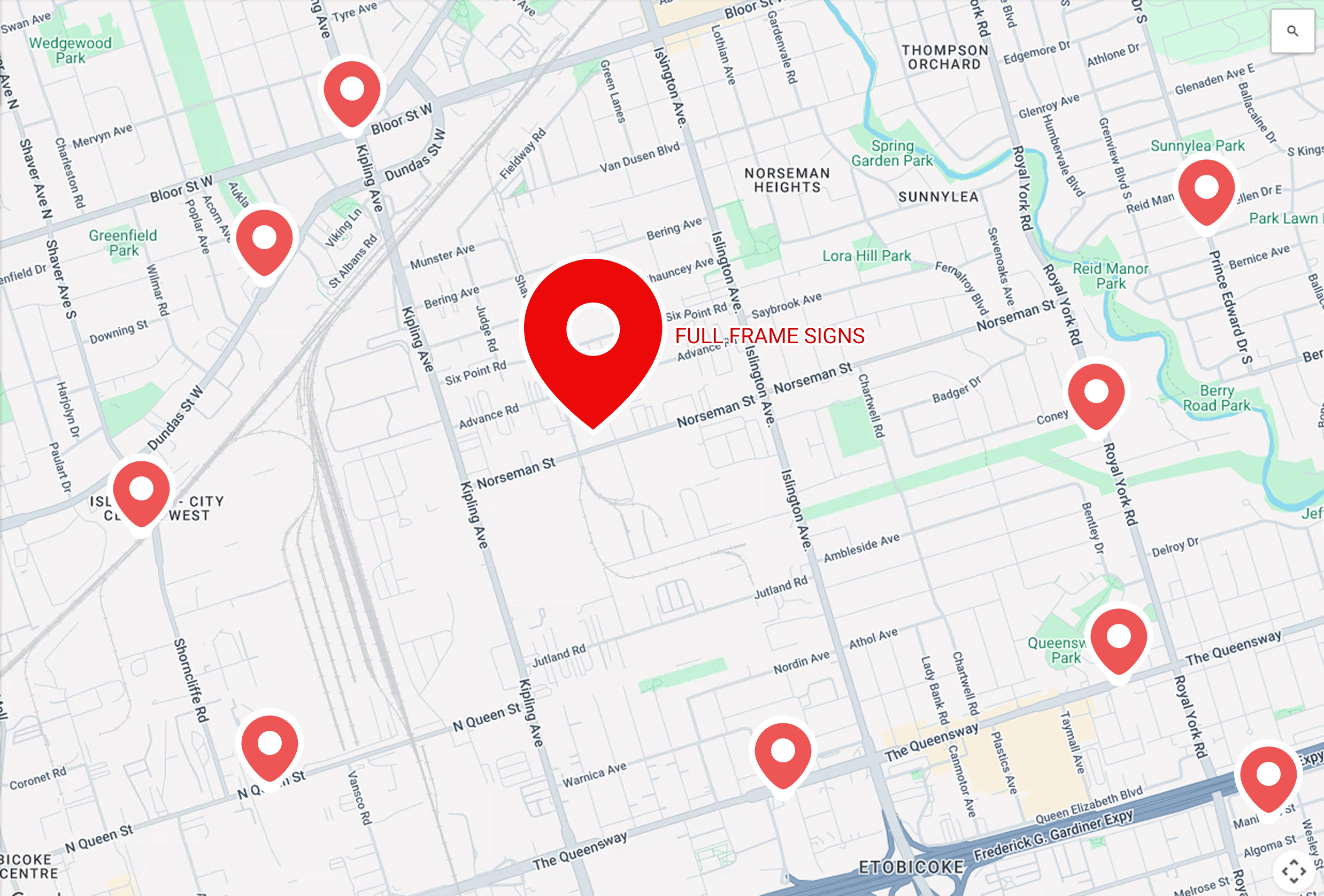
200 Norseman St, Unit 100, Etobicoke, ON M8Z 2R4
Call: (416) 231-7854
FAQ
Q: Can you print and cut a sign to match my logo shape?
A: Yes. We print the artwork directly on the material and cut it to your logo outline, as long as we have vector artwork and a clear outline.
Q: What materials can be UV printed and CNC cut?
A: Common options include ACM, PVC, acrylic, and foam board. The best choice depends on whether the sign is indoor or outdoor and how long it needs to last.
Q: Can you handle a project that combines several services?
A: Yes. Many jobs combine printed panels, routed pieces, vinyl graphics, and wayfinding or floor graphics. Ordering together keeps colours and finishes consistent.
Q: Can you produce a one-off or small quantity?
A: Yes. Custom-shaped signs are often single pieces or small runs. Contact us with your size and quantity.