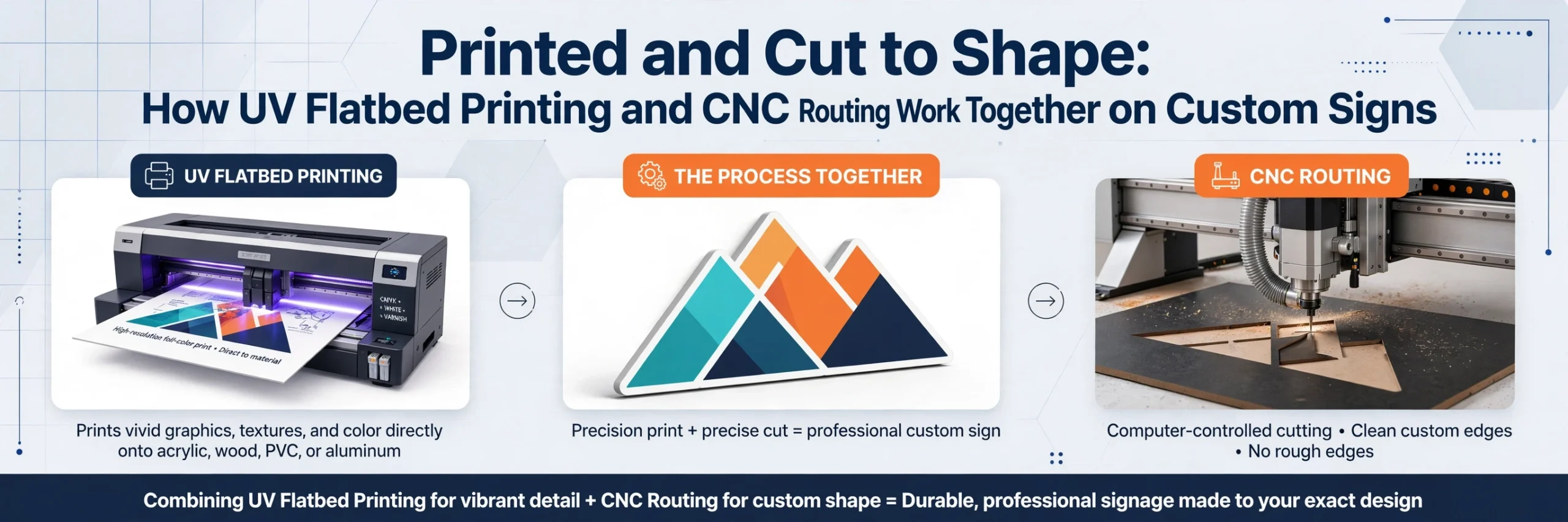
Looking for high-impact UV printing applications in Toronto? Partner with Full Frame Signs for expert UV flatbed printing in Toronto, rigid board printing, and precision CNC routing across the GTA.
Beyond Paper: How Toronto Businesses Are Using UV Flatbed Printing for Custom Projects
When designing custom physical displays, retail signage, or interior architectural features, standard print media isn’t always the best fit. Rolling graphics onto paper or mounting printed vinyl over rigid boards often introduces issues like peeling edges, air bubbles, and material limitations. For non-standard materials and rigid display surfaces, direct-to-substrate UV flatbed printing in Toronto changes the production workflow entirely.
Direct-to-Substrate Guide GTA: Quick Overview
Instead of printing onto film and applying it manually, UV flatbed printing applies specialized ink directly onto the final material surface—curing it instantly with ultraviolet light. Here is a practical breakdown of how Toronto and Etobicoke businesses navigate signage substrate selection, structure artwork files, and evaluate direct printing for custom visual projects.
The Core Advantage: Printing Directly to Rigid Surfaces
Traditional large-format setups rely on flexible rolls of paper, vinyl, or canvas. Making a rigid sign traditionally requires printing a graphic, laminating it, and manually mounting it to a backing board. UV flatbed printing streamlines this into a direct, single-pass process:

Traditional Mounted Workflow:
[ Print to Film ] ➔ [ Add Protective Laminate ] ➔ [ Mount to Substrate ]
Direct Flatbed Workflow:
[ Place Rigid Board on Bed ] ➔ [ Direct UV Print & Instant Light Cure ]
Because the inks are cured instantly under high-intensity ultraviolet lamps, they bond to the surface without bleeding or requiring drying time. This allows graphics to maintain crisp details even on rigid, non-porous, or textured surfaces.
3 Practical UV Printing Applications in Toronto
Instead of viewing UV printing solely through technical specifications, it helps to look at how different industries across the Greater Toronto Area apply direct printing to real-world installations:
1. Retail & Point-of-Sale (POS) Displays
Materials Used: Acrylic, Expanded PVC (Sintra), Foam Board.
Why Direct Printing: High-traffic retail environments require high-contrast imagery that withstands handling. Direct printing onto acrylic or PVC avoids edge-peeling, giving displays a polished visual finish. Explore our range of window graphics in Toronto for complementary store displays.
2. Commercial Spaces & Hospitality Interiors
Materials Used: Brushed Aluminum Composite (ACM), Birch Plywood, Architectural Tiles.
Why Direct Printing: Custom restaurant wall panels, office feature walls, and reception art utilize the material’s natural texture (such as real wood grain or metallic brushed finish) as an active component of the visual background.
3. Events, Trade Shows & Construction Site Signage
Materials Used: Coroplast (Corrugated Plastic), Gatorboard, Heavy-Duty ACM Panels.
Why Direct Printing: Direct prints maintain clarity on outdoor perimeter boards and temporary event displays without adding extra production steps. For temporary commercial needs, see our emergency window graphics guide.
Signage Substrate Selection: What Can (and Can’t) Be Printed?
While commercial flatbed UV printers accommodate flat materials up to 4′ × 8′ sheets (or larger tile configurations), careful preparation dictates adhesion performance.
- Surface Adhesion & Porosity
- Panel Thickness & Weight Capacities
- Environment (Indoor Durability vs. Outdoor Exposure)
- White Ink Underbase Requirements
- Smooth or Non-Porous Surfaces (Glass, Polished Metal): Require specialized liquid primers or corona treatments so the cured ink forms an unbreakable chemical bond.
- Textured Surfaces (Wood, Fabric-Backed Panels): Absorb light and ink differently. Printing a dedicated spot white ink layer beneath color artwork helps retain vibrant color accuracy over dark or patterned surfaces.
- Outdoor Weatherability: Ensure raw panels comply with local standards, such as the City of Toronto Sign By-law Guidelines, to guarantee outdoor installations remain safe and compliant.
Production Tip: Never assume every rigid panel behaves identically. Testing a sample cut or reviewing manufacturer specifications prior to full production guarantees flawless surface adhesion.
UV Flatbed Direct Print vs. Traditional Applied Vinyl
Determining whether direct-to-substrate printing is right for a specific project depends on installation longevity and physical geometry:
| Project Factor | UV Flatbed Direct Print | Applied Vinyl Graphics |
|---|---|---|
| Primary Use Case | Rigid panels, custom substrates, flat displays. | Curved vehicle wraps, flexible surfaces, short-term decals. |
| Surface Finish | Prints directly on wood, acrylic, metal, or PVC. | Requires smooth, pre-finished backing boards. |
| Layering Capabilities | Supports spot white ink & textured gloss layers. | Requires double-layer film applications. |
| Long-Term Durability | Eliminates risk of vinyl bubbling or edge lifting. | May peel over time if exposed to high friction/heat. |
Checklist: Is Direct UV Printing Right for Your Project?
Ask yourself these four questions when evaluating your next commercial display run:
- Substrate Type: Are you printing on a flat, rigid material (Acrylic, ACM, PVC, Wood, Coroplast)?
- Natural Aesthetics: Do you want the substrate’s natural texture, grain, or metallic color to remain visible?
- Artwork Complexity: Does the artwork require spot white ink underbases on transparent or dark backgrounds?
- Post-Processing: Is the finished piece going to be precision-routed or cut into custom shapes after printing?
If you answered “yes” to most of these questions, direct UV flatbed printing is likely the most efficient production method for your job.
Custom Material Printing in Etobicoke & Toronto
Choosing the right substrate, prepping vector artwork, and selecting appropriate surface finishes are the most important steps in creating clean, long-lasting visual displays. Working with an experienced shop ensures your graphics look sharp and adhere correctly. Review our advice on choosing a local print partner in Toronto to guide your next project.
At Full Frame Signs, we handle direct-to-substrate flatbed printing and precision CNC routing under one roof at our Etobicoke facility. Whether you need material recommendations, white ink setup guidance, or an accurate quote, our local production team is ready to assist.
“Direct UV printing bridges the gap between raw construction materials and high-end visual design—delivering durable, high-resolution graphics directly onto wood, metal, and acrylic.”